


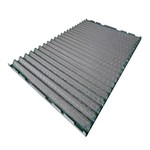

Kintted Wire Mesh
Kintted wire mesh is a type of wire fabric manufactured by a circular knitted machine. It can be made of various materials, such as stainless steel, copper, nickel, Monel, Teflon plastic and other alloy materials.
Benefits of Kintted Wire Mesh
Mitigates Rust
Stainless steel doesn't rust in the same way as other materials. The product is designed to withstand harsh environments and moisture. So, you don't have to worry about degradation over the long term.
Offers Durability
In applications such as machine guarding and fencing, the strength of the material used is a major consideration. Kintted wire mesh offers exceptional durability. It provides lasting value in commercial and industrial applications.
Ready to Use
Other metals require a finish to be added to be used for woven wire mesh applications. Stainless steel is designed to be immediately used in your organization.
The product's stainless finish will ensure it retains its aesthetic qualities while providing a level of strength unmatched by any other structural metal.


Why Choose us
Experience and expertise
Our company strives for survival by quality and development by reputation. After years of development, it has established its own production and processing site, covering an area of about 30,000 square meters. It has grown to hundreds of employees.
Cutting-edge technology
The company is committed to the development of real industrial technology, Production of various specifications of stainless steel screens, petroleum vibrating screens, decorative nets, mud nets, expanded metal, punched plates, gas-liquid filters, wedge wire filter tubes and other products.
Excellent customer service
Our customer service team is dedicated to ensuring our clients receive prompt and professional services.
How Is Kintted Wire Mesh Made?
Wire weavers must use specialized looms designed to handle the metallic wires used to fabricate kintted wire mesh. Warp wires in the vertical direction must be threaded through frame systems referred to as heddle frames as well as a read to ensure the mesh specification meets tight tolerance standards.
As the loom begins weaving, a small portion of wire is fed through the loom. A mechanism at the front of the loom called the front take-up mechanism winds the woven wire.
Now, at the exact moment the portion of warp wires is fed through the loom, the first set of heddle frame pulls a specific portion of warp wires up, and the second set of heddle frames pull the other portion of warp wires down.
When this occurs, a weft wire is shot between the sets of wires via a rapier band. The rapier band will then snap back to its resting position, at which point the read slams the weft wire into position.
This leaves you with the precise cross-section kintted wire mesh is known for.
At this point, the read snaps back to its original position, more warp wire is fed through the loom, and the heddle frames swap position. This cycle is repeated until the weaving process is complete.

The most critical difference when comparing kintted wire mesh to knitted wire mesh, has to do with the profile of the openings.
Kintted wire mesh is woven with rigid wires and to tight tolerances, resulting in pore openings that are relatively permanent and extremely precise. Knitted wire mesh, on the other hand, have more sleazy characteristics meaning the loop openings tend to vary in size and spacing.
Another key difference between the two media comes down to their overall formability.
While kintted wire mesh is rigid, there are processes you can apply to deep draw, roll, bend, and otherwise form the mesh to fit a specific application. That said, the knitted profile of knitted wire mesh allows it to be stretched, rolled, bent, etc., with far fewer limitations.
But what is right for me? Well, you must consider the needs of the application.
If your process requires a durable screening media that can provide precise screen/filtration for prolonged periods of time, kintted wire mesh will most likely be a better fit. However, if the formability requirements of the media outweigh the accuracy requirements, knitted wire mesh will best suit your process.
Application of Kintted Wire Mesh
Shielding
- Knitted wire mesh made of stainless steel wire, copper wire, nickel and monel wires has excellent shielding performance in the applications. The main products used in the shielding applications are knitted wire mesh gasket and knitted wire mesh tape.
- Knitted wire mesh gasket can be all-metal or knitted wire mesh with elastomer or foam core. Different shapes and styles of knitted wire mesh gasket is mainly used in the removable doors, panels and sheets used in the EMI/RFI shielding applications. It have excellent sealing and shielding performance.
- Kintted wire mesh tape is mainly used in the cable shielding applications. It can be twined or covered onto cables for excellent shielding performance. Kintted wire mesh gasket can be stainless steel, copper or brass materials.
Filtering
- Kintted wire mesh has outstanding advantages than other products used in filtering gas and liquid. Knitted mesh can be made into metal or PP materials wire mesh for different applications and environments. The typical products of knitted mesh used for filtering are knitted wire demister pad, knitted mesh mist eliminator, compressed knitted mesh and knitted mesh engine breather.
- The knitted wire demister pad refers to device made of PP wires to eliminate and remove droplets in the gas.
- The knitted mesh mist eliminator has the similar function with the demister pad, but it is made of metal wires, which are acid and alkali resistance and high temperature resistance.
- Compressed kintted wire mesh can be used in the airbags to prevent the particles from entering the airbag and affect the performance of airbag. It can also be used in the gas and liquid separators for gas and liquid separating and filtering.
- Knitted mesh engine breather refers to the device with kintted wire mesh in the engines. It can remove the oil and moisture droplets in the emission to reduce emission and protect air environment.
Cleaning
- Kintted wire mesh is soft and excellent cleaning performance. it can be used in the industrial and our daily life for cleaning applications. The main products used in the cleaning application are knitted copper cleaning mesh and knitted cleaning balls.
- The knitted copper cleaning mesh refers to the knitted cleaning mesh made of copper or tinned copper steel wire. The knitted copper cleaning mesh is commonly used in the industrial fields to clean the inside and outside of mechanical parts. Soft structure will not leave scratches.
- The knitted cleaning balls can be copper, brass, galvanized and stainless steel. Various materials of cleaning balls are widely used in our daily life to clean the kitchenware, including chopping boards, pans, gas cookers.
Muffling
Kintted wire mesh used for muffling refers to the knitted wire muffler, which is widely used in the automotive and other applications. The knitted wire muffler is made of stainless steel wire and galvanized wire, they all have excellent corrosive and rust resistance to be used in the harsh environments. Knitted wire muffler can be a physical barrier to trapping the noise in the element. Additional, the knitted wire muffler can also be installed on the fasteners of exhaust pipe and other parts for vibration attenuation and noise reduction.
Types of Kintted Wire Mesh


Brass Compressed Knitted Wire Mesh:
Crafted from brass wires, this mesh offers corrosion resistance and electrical conductivity, making it suitable for various industrial applications.
Brass Ginning Knitted Wire Mesh:
This type of knitted wire mesh, made from brass, is known for its fine mesh and high filtration efficiency, commonly used in liquid and gas filtration processes.
Bronze Compressed Knitted Wire Mesh:
Manufactured from bronze wires, this mesh exhibits excellent corrosion resistance and is favored for applications demanding durability and strength.
Carbon Steel Knitted Wire Mesh Demister Pad:
Utilized in demister applications, this mesh made of carbon steel provides effective separation of liquid droplets from gas streams.
Column Shape Compressed Knitted Wire Mesh:
This specialized knitted wire mesh is designed in a column shape, offering unique filtering capabilities for specific industrial applications.
Copper Compressed Knitted Wire Mesh:
Known for its high electrical conductivity and corrosion resistance, copper knitted wire mesh finds applications in electrical and electronics industries.
his type, made of copper, is characterized by a ginning pattern which enhances its filtration efficiency and is commonly used in various liquid and gas filtration processes.
Cylinder Shape Compressed Knitted Wire Mesh:
Designed in a cylindrical form, this wire mesh type is used in specialized filtration systems and other industrial applications.
Disc Shape Compressed Knitted Wire Mesh:
This knitted wire mesh, formed in a disc shape, is employed in filtration processes where a flat, compact form is required.
Hastelloy Compressed Knitted Wire Mesh:
Made from Hastelloy alloy, this mesh is highly resistant to corrosion, particularly in harsh chemical environments, making it suitable for demanding applications.
Inconel Compressed Knitted Wire Mesh:
Composed of Inconel alloy, this mesh type is known for its high-temperature resistance and is often used in extreme industrial environments.
Iron Compressed Knitted Wire Mesh:
This type of mesh, made from iron wires, provides strength and durability, making it a cost-effective solution for various industrial applications.
Knitted Wire Mesh Roll:
Available in roll form, this versatile mesh is easily customizable and widely used for applications such as filtration, gasketing, and insulation.
Monel Compressed Knitted Wire Mesh:
Crafted from Monel alloy, this mesh offers exceptional resistance to corrosion and erosion, making it suitable for marine and chemical processing applications.
Monel Ginning Knitted Wire Mesh:
This type, made from Monel alloy, is characterized by a ginning pattern, providing enhanced filtration efficiency in challenging environments.
Nickel Compressed Knitted Wire Mesh:
Constructed from nickel wires, this mesh type is known for its high thermal and electrical conductivity, making it valuable in specialized industrial applications.
Nickel Ginning Knitted Wire Mesh:
Featuring a ginning pattern and made from nickel, this mesh provides efficient filtration in demanding environments, commonly used in chemical processing.
Oval Shape Compressed Knitted Wire Mesh:
Designed in an oval shape, this mesh type offers unique filtering capabilities and is suitable for specific industrial applications.
Rectangular Shape Compressed Knitted Mesh:
With a rectangular form, this knitted wire mesh is used in applications where a specific shape is required for effective filtration or separation.
Ring Shape Compressed Knitted Wire Mesh:
Formed in a ring shape, this wire mesh is utilized in specialized filtration systems and other industrial applications.
Choosing The Right Kintted Wire Mesh
Aperture Size
This determines the size of the particles to be eliminated. We offer as standard meshes from 35mm to 25 microns (0.025mm) compliant with ISO standard 4783. Where screening requires very tight tolerances, the manufacturing tolerances of the mesh must also be taken into consideration.
Wire Diameter
Selecting the wire diameter involves a number of different considerations. The thicker the wire, the stronger and more robust the mesh and the longer the service life. On the other hand, a thicker wire will reduce the open area and therefore reduce screening or sifting performance.
Reducing the wire diameter, whilst maintaining the same aperture size, increases the number of apertures within a defined surface area. Both performance and efficiency will increase.
Materials
The most popular material is stainless steel to DIN 1.4301 (AISI 304) or DIN 1.4401 (AISI 316); selected specifications are also available in chrome steel to DIN 1.4016 (AISI 430).
Mesh Dimensions
Standard widths are 1245mm or 1580mm, but depending on the weaving equipment used slight variances are common. Standard roll length is 30m, individual pieces cut to size are available.
Mesh Selection
The mesh selection, particularly with fine meshes, depends on many process details and often can only be selected by carrying out trials.
The open area is influenced directly or indirectly by the service life of the screen, this is illustrated in the following table.
Understanding kintted wire mesh
Kintted wire mesh‘s flexibility and strength stem from its unique construction, where individual wires intersect at precise angles to form a uniform pattern. This structure not only provides excellent durability but also allows for varying degrees of openness and strength, depending on the application. The steel used in making this mesh can range from bare carbon steel to high-grade stainless steel, offering different resistance levels to factors like corrosion, heat, and wear. By comprehending these characteristics, users can make more informed decisions about the type of kintted wire mesh best suited for their needs.
Routine cleaning and maintenance
Aside from regular cleaning, inspect the mesh for any signs of damage or wear that cleaning might not address. More frequent cleaning may be necessary for areas exposed to harsher conditions, such as outdoor environments or industrial settings. After cleaning, thoroughly dry the mesh to prevent any residual moisture, which can be a precursor to rust, especially in iron-based meshes. This routine care is not just about maintaining appearance; it's a critical step in preserving the structural integrity of the mesh over time.
Corrosion prevention of steel kintted wire mesh and other variants
When you choose coatings to prevent rust, consider where you will use the wire mesh. When the mesh is exposed to the elements, galvanising is a good option for outdoor use. Powder coating is better for indoor use when appearance is important. The mesh might need unique layers to last in places with lots of chemicals or extreme heat. Applying these protective coatings is part of a long-term maintenance plan.
Proper installation and handling
Correct installation of kintted wire mesh involves more than just physical placement. It requires understanding the load-bearing capabilities and the type of support structure needed for the specific application. Using proper tools and techniques during installation can prevent unnecessary strain or damage to the mesh. Additionally, educating staff or users about the correct way to handle and interact with the mesh can prevent accidental damage or misuse, which often leads to premature wear.
Regular inspections
Inspect the surface, connections, and anchor points of the mesh. It's crucial to keep all connections tight and secure in places with a lot of movement or pressure. By documenting these inspections, we can track the condition of the mesh over time. It helps us be proactive about maintenance and repairs.
Our Factory
Our company strives for survival by quality and development by reputation. After years of development, it has established its own production and processing site, covering an area of about 30,000 square meters. It has grown to hundreds of employees.
The company is committed to the development of real industrial technology, Production of various specifications of stainless steel screens, petroleum vibrating screens, decorative nets, mud nets, expanded metal, punched plates, gas-liquid filters, wedge wire filter tubes and other products. At present, the main sales areas are North America (United States, Canada, Panama), Europe (Russia, Germany, France, Sweden), Asia, the Middle East, and Southeast Asia.
